
.png)




DISCOVER THE STORIES BEHIND THE PLACE WE CALL HOME
OF
PASCO COUNTY
%20(1).png)
From early settlements and railroads to coastal communities, local landmarks and the cities we know today—discover the people, places and events that helped shape our corner of Florida.

EXPLORE THINGS TO DO
IN PASCO COUNTY
PASCO COUNTY
RESOURCES
Local History of Pasco County, Florida
Discover the Stories Behind the Communities We Call Home

There’s more to Pasco County than the places, businesses and neighborhoods we see today. Its history has been shaped by Native peoples, early settlers, pioneers, farmers, ranchers, railroads, agriculture, fishing and generations of families who helped turn small settlements into the growing communities we know today.
There’s more to our communities than the places, businesses and neighborhoods we see today. Pasco and Pinellas counties have histories shaped by Native peoples, early settlers, railroads, agriculture, fishing, sponge diving, tourism, development and generations of families who helped turn small settlements into the communities we know today.
The Locals is all about connecting people with the communities where they live, work and play—and we think knowing a little about where those communities came from is part of that connection.
Whether you’ve lived here your entire life, recently moved to the area, or simply enjoy discovering interesting pieces of local history, we invite you to explore the stories of Pasco and Pinellas County, Florida.


Explore Our
LOCAL HISTORY
History of Pasco County, Florida
Pasco County was established in 1887, but its story began long before the county had a name. Native peoples, pioneers, farmers, ranchers, railroad workers and entrepreneurs all played a part in shaping the area.
Over the years, communities such as New Port Richey, Port Richey, Hudson, Holiday, Trinity, Odessa, Land O' Lakes and Wesley Chapel developed their own identities while becoming part of the larger story of Pasco County.
Explore how Pasco County got its name, how its early communities developed, the role railroads and agriculture played in its growth, historic landmarks that remain today and some of the people and events that helped shape the county.
Long before Pasco County was established, the land that makes up the county today was home to Native peoples who lived throughout Florida for thousands of years. The area's rivers, lakes, forests and Gulf Coast provided access to fresh water, fish, wildlife and other natural resources that supported early communities.
Over time, Florida came under Spanish, British and eventually American control. As settlement expanded during the 1800s, more families began establishing farms, ranches and small communities throughout the region that would eventually become Pasco County.


Before
Pasco County

HAD A NAME
The landscape looked very different from the Pasco County we know today. Much of the area was rural and sparsely populated, with pine forests, wetlands, open range and small settlements connected by trails and primitive roads.
DID YOU KNOW?
Did you know Pasco County was created in 1887when the southern portion of Hernando County was divided to form Pasco County.
How
Pasco County
GOT IT'S NAME

JUNE 2, 1887
PASCO COUNTY IS OFFICIALLY ESTABLISHED

Pasco County officially came into existence on June 2, 1887, when the Florida Legislature divided what was then Hernando County into three counties: Hernando, Citrus and Pasco.
The new county was named for Samuel Pasco, a prominent Florida attorney, politician and Confederate veteran who had served as president of Florida's 1885 Constitutional Convention and was elected to the United States Senate in 1887.
At the time the county was created, choosing a county seat became an important decision. Dade City ultimately became the county seat and developed into an important center for government, commerce and transportation in eastern Pasco County.


The Railroad
CHANGES
Pasco County
The arrival of the railroad was one of the most important developments in Pasco County's early growth.
During the late 1800s, expanding railroad lines made it much easier to move people, agricultural products, lumber and supplies throughout Florida. Communities that had once been relatively isolated suddenly had better connections to larger cities and markets.
Railroad stops helped small settlements grow into established communities. Businesses opened near the tracks, farmers gained new ways to ship their crops, and new residents arrived looking for land and opportunity.
The railroad's influence can still be seen in several of Pasco County's historic communities today.

Farming, Ranching
HELP BUILD THE COMMUNITY
&
Citrus

Agriculture played a major role in Pasco County's early economy. Families raised cattle, grew vegetables and produced citrus, while timber and other natural resources also supported local businesses and employment.
Citrus became especially important in parts of the county. Orange and grapefruit groves were once a familiar part of Pasco's landscape, and packing houses and railroads helped growers send Florida citrus to markets far beyond the county.
Cattle ranching also has deep roots in this part of Florida. Long before subdivisions and shopping centers covered much of the landscape, ranches, farms and open land stretched across large portions of Pasco County.

GULF COAST
PASCO COUNTY'S
COMMUNITIES


While agriculture and railroads influenced much of inland Pasco County, communities along the Gulf developed their own stories.
Fishing, boating and access to the Gulf helped shape western Pasco County. Communities such as Port Richey, New Port Richey and Hudson grew along or near the water, attracting residents, visitors and businesses.

The Pithlachascotee River—often simply called the Cotee River—became especially important to Port Richey and New Port Richey. Today, the river remains one of the most recognizable natural features of western Pasco County.
NEW PORT RICHEY
Hollywood
AND FLORIDA'S
CONNECTION
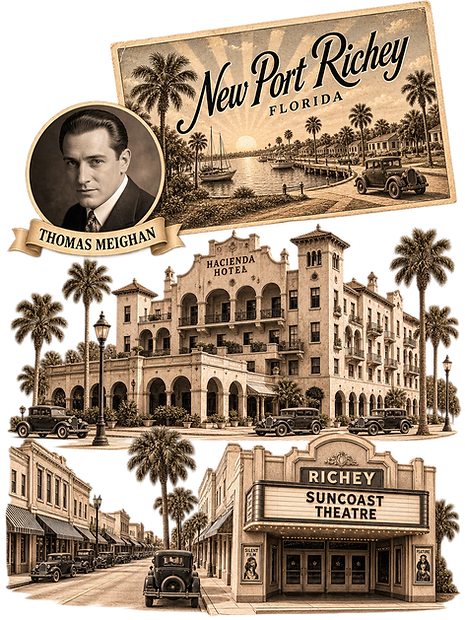


New Port Richey has one of Pasco County's more unusual chapters of local history.
During the 1920s Florida land boom, community leaders promoted New Port Richey as an attractive destination for wealthy residents and celebrities. Several well-known entertainers became associated with the area, including silent-film star Thomas Meighan.
That excitement helped shape downtown New Port Richey. The 1920s brought ambitious development, including the Hacienda Hotel, new businesses and entertainment venues that reflected the city’s hopes of becoming a fashionable Florida destination.

Although New Port Richey never became the Hollywood-style destination some promoters envisioned, that colorful period remains an important part of the city's identity
FROM RURAL COMMUNITIES TO A
Growing Suburban County
The construction and expansion of major transportation routes—including U.S. 19, Interstate 75 and the Suncoast Parkway—made it easier to travel between Pasco County and the larger Tampa Bay region and contributed to additional residential and commercial growth.


For much of its history, Pasco County remained largely rural. That began changing dramatically during the second half of the twentieth century.
New roads, housing developments and businesses brought increasing numbers of residents to the county. Communities including Holiday, Land O' Lakes, Trinity, Odessa and Wesley Chapel experienced significant development, while established communities such as New Port Richey, Port Richey, Hudson, Dade City and Zephyrhills continued to grow.
Pasco County Today
Today's Pasco County is a combination of old and new.


Historic downtowns, longtime neighborhoods, ranches and reminders of old Florida exist alongside master-planned communities, shopping districts, new schools and rapidly developing neighborhoods.

You can still find traces of the county's past in historic buildings, old railroad routes, community names, cemeteries, parks and landmarks scattered throughout Pasco County.


And as the county continues to grow, its history continues to grow with it.